
Home Smith Machines
Refine
Sort by
Resistance
Max user weight
Total load capacity
Features
Brand
Customer rating
More like this


What is a home smith machine?
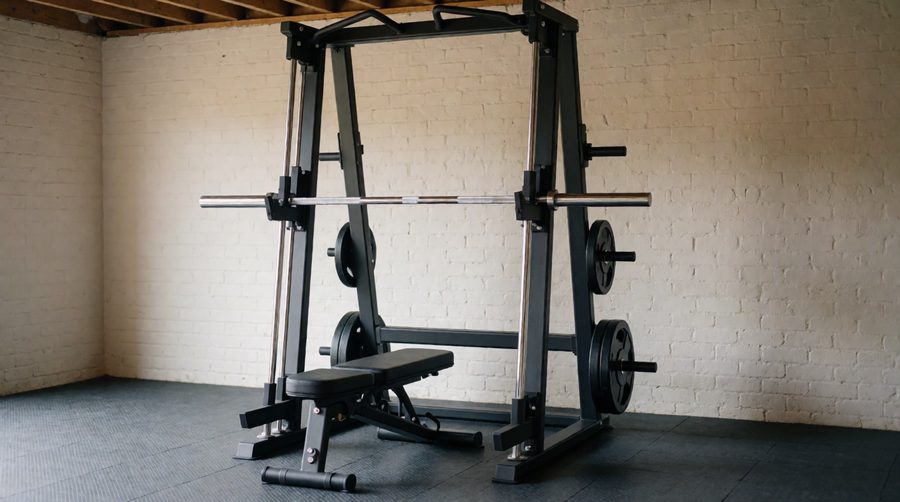
A smith machine is a barbell that slides up and down inside two steel guide rails. Hooks on the carriage let you rack it at any point in the lift: rotate your wrists and it locks onto the next slot. Adjustable safety stops sit underneath, so if a rep goes wrong the weight lands on the stops rather than on you. That is why so many people pick a smith machine for a home gym, where there is usually nobody to help.
A home model is the same idea built to fit a house. Commercial versions can weigh hundreds of kilos and need a gym floor; home versions are lighter, shorter and often double up as a power rack with cables, so one smith machine replaces several pieces of kit. Brands such as Force USA, Marcy and Body-Solid all make versions sized for garages and spare rooms.
Types of smith machines
Vertical smith machine
The rails run straight up at 90 degrees. This is the most common layout on home models, including every machine in our range. A vertical smith machine is simple, compact and works well for squats, bench press, overhead press and rows.
Angled smith machine
The rails lean back by around 5 to 7 degrees, which gives a movement closer to a free barbell squat or press. Angled frames are mostly commercial and take up more floor depth.
Counterbalanced smith machine
A counterweight or cable takes some of the bar's weight, so the empty barbell feels lighter. That helps beginners and anyone doing light rehab or isolation work. Most budget home frames are not counterbalanced, so the empty barbell is part of your load.
Half rack and power rack combos
A rack with smith machine built in gives you hooks and safety arms for a free barbell, plus the guided one for heavy solo sets. The Marcy SM-4903 and Jelens M12 in our range work like this.
All-in-one smith machine
The all-in-one smith machine adds cable pulleys, a chin-up bar, dip handles and sometimes a landmine or leg press plate to the frame. It is essentially a functional trainer and a rack in one, and the best way to fit a full home gym into one footprint. Force USA's G-series trainers are the best-known example; on Amazon, the Jelens and Sportnow frames follow the same functional trainer idea at a smaller size.
Smith machine attachment
If you already own a power rack, some brands sell a smith machine attachment that bolts inside it. Each attachment only fits racks from the same maker and series, so check compatibility before you buy. Other rack attachments, such as a lat pulldown seat or low row footplate, add cable work in the same way.
Home smith machines compared
These figures come from each listing's specification. Capacity ratings are not measured the same way: some brands quote the bar, some the whole frame and some the maximum user weight, so read the label next to each number.
| Model | Height | Footprint (approx.) | Rated capacity | Plates | Cables |
|---|---|---|---|---|---|
| Body-Solid Powerline PSM144X | 203cm | 193 x 114cm | 181kg (bar) | 1 inch (2 inch sleeves extra) | None |
| Powertec Roller Smith WB-RS19 | 210cm | 210 x 107cm | 204kg (bar) | 2 inch | None (lat tower optional) |
| Marcy SM-4903 | 216cm | 218 x 185cm | 272kg (max user), 135kg on rack | 1 and 2 inch | Dual high and low pulleys |
| Jelens M12 | 223cm | 138 x 127cm | 907kg (frame) | 2 inch | Dual independent pulleys |
| Sportnow 3-in-1 | 225cm | 180 x 165cm | 120kg (max load) | 25mm and 50mm | Dual, 25kg per side |
Put simply: the Body-Solid and Powertec are pure guided-barbell frames, the Marcy is the most complete package with a seat in the box, the Jelens fits the most kit into the least floor space, and the Sportnow 3-in-1 is the lightest-duty option with a 120kg limit and EN 20957 certification.

How to choose a smith machine for home
Ceiling height and floor space
Height is the first thing to check. The machines above range from 203cm to 225cm, and you need room above the frame for chin-ups and to press overhead at full stretch. Many UK rooms have ceilings of around 2.4m, so measure yours, and the doorway you will carry the boxes through, before you order. Allow at least 60cm of clear space around the sides for loading. If space is tight, our compact multi gyms are worth a look.
Bar path and bearings
How smoothly the carriage runs decides how a smith machine feels. Linear ball bearings, as on the Marcy, give the most fluid movement. Powertec uses sealed-bearing, nylon-reinforced rollers, and the Body-Solid uses nylon Super-Glide bushings on chrome guide rods. Cheaper bushings can feel sticky if the rods aren't kept clean.
Weight capacity
Buy for where your strength training will be in a year, not where it is now. A 120kg limit is fine for most beginners, but anyone squatting heavy should look at 180kg or more, or browse our heavy duty home gyms. Remember that your own body weight is also on the bench and the floor.
Standard or Olympic plates
Standard plates have a 1 inch (25mm) hole and Olympic plates a 2 inch (50mm) hole. The Body-Solid bar is 1 inch, so it needs adapter sleeves for Olympic plates; the Powertec and Jelens take 2 inch plates. If you already own weights, match the bar to them.
Safety catches and J-hooks
Look for plenty of lockout slots and safety stops that adjust low enough for floor work. The Body-Solid has 14 lockout positions and dual-lock spotter catches; the Sportnow's rack adjusts through 17 levels from 25 to 185cm.

Cables and attachments
Plate-loaded cables turn a smith machine into a basic functional trainer, adding lat pulldowns, low rows, triceps pushdowns and flyes without a weight stack. If cable work matters most, compare our cable crossover machines or a 90kg weight stack gym, which is quicker to adjust.
Seating, delivery and assembly
Only the Marcy here comes with a bench. For the others you'll need a flat or adjustable one that slides under the smith machine - see our weight bench multi gyms. These frames arrive in two or three heavy boxes (the Marcy comes by two-man delivery), and the Body-Solid quotes 1.5 to 2 hours to build, so plan for two people.
Quick checklist before you order a smith machine:
- Room height, with at least 10-15cm spare above the frame
- Floor space, plus about 60cm each side for loading
- Bar capacity, and what the rating actually covers
- Bar sleeve size: 1 inch or 2 inch
- Number of lockout slots and how low the stops go
- Cables, seating and attachments included or extra
Smith machine vs free weights and a power rack
With free weights you balance the bar yourself, which trains the small stabilising muscles and carries straight over to sport. A smith machine fixes the bar path, so you can push closer to failure safely, isolate one muscle group and train alone. Neither is better; they do different jobs, and a smith machine is a good way for a beginner to learn squat and press patterns with a built-in safety net.
A power rack with a free barbell is the closest home alternative. Combo frames like the Jelens M12 give you both: J-hooks for barbell squats, plus the smith machine for heavy solo sets. Many lifters use the smith machine for accessory work, such as split squats, incline presses and calf raises, alongside free-weight main lifts.
What you can train on a smith machine
- Legs: squats, split squats, lunges, hip thrusts, calf raises and Romanian deadlifts. For isolation work, add a leg extension machine.
- Chest: flat, incline and decline bench press - see our bench press multi gyms.
- Back: bent-over and inverted rows, plus lat pulldowns and low rows on models with cables.
- Shoulders and arms: seated overhead press, upright rows, shrugs and close-grip press; cable curls and pushdowns on all-in-one frames.
- Bodyweight: chin-ups and dips on the Marcy's multi-grip chin bar and dip handles.

Using a smith machine safely
Set the safety stops before you add any weight: just below the lowest point of your rep, so a failed lift lands on them. Learn how to rack and unrack with a wrist turn using an empty bar first, fit collars, and load both sides evenly. Bolt or level the frame if the manufacturer recommends it, and put rubber mats under it to protect the floor.
The NHS recommends strengthening activities that work all the major muscle groups on at least 2 days a week, and its strength exercises guide is a good place to start if you are new to resistance training. Manufacturers publish full specs and accessory options, such as the Powertec Roller Smith Machine page.
Smith machine FAQs
How much does a smith machine bar weigh?
It varies by model. Many home bars weigh roughly 7-11kg, less than a 20kg Olympic barbell, while counterbalanced commercial bars can feel almost weightless. Check the listing, or weigh the empty bar on bathroom scales, so you can log your lifts accurately.
Can I use a smith machine on my own?
Yes, that is the main reason to own one. With the safety stops set at the right height you can train to failure with nobody watching.
How much ceiling height do I need?
Add at least 10-15cm to the machine's height for assembly and clearance, and more if you plan to do chin-ups on the top crossbar. A 203cm frame like the Body-Solid suits lower rooms better than a 225cm all-in-one.
Can you deadlift on a smith machine?
You can do Romanian deadlifts and rack pulls, but the fixed vertical path doesn't suit a full deadlift from the floor for most people, and the lowest catch is often above floor height.
Is a smith machine better than a multi gym?
A smith machine is better for heavy barbell squats and presses; a weight-stack multi gym or functional trainer is quicker for circuits and cable work. All-in-one frames like the Marcy SM-4903 bridge the two. If you like the brand, see our Marcy home gyms, or compare Strongway multi gyms.